
The Library
The Library is where I have gathered what I would tell you if you were sitting across the table from me: what a first canvas needs, what the unfamiliar words mean, how the two stitches go, which thread will give a piece the character you want, and what happens after the last intersection is covered. If you are new to the craft, begin at the top and make your way down; if you have come looking for something in particular, go straight to the shelf that holds it.
What You Will Need
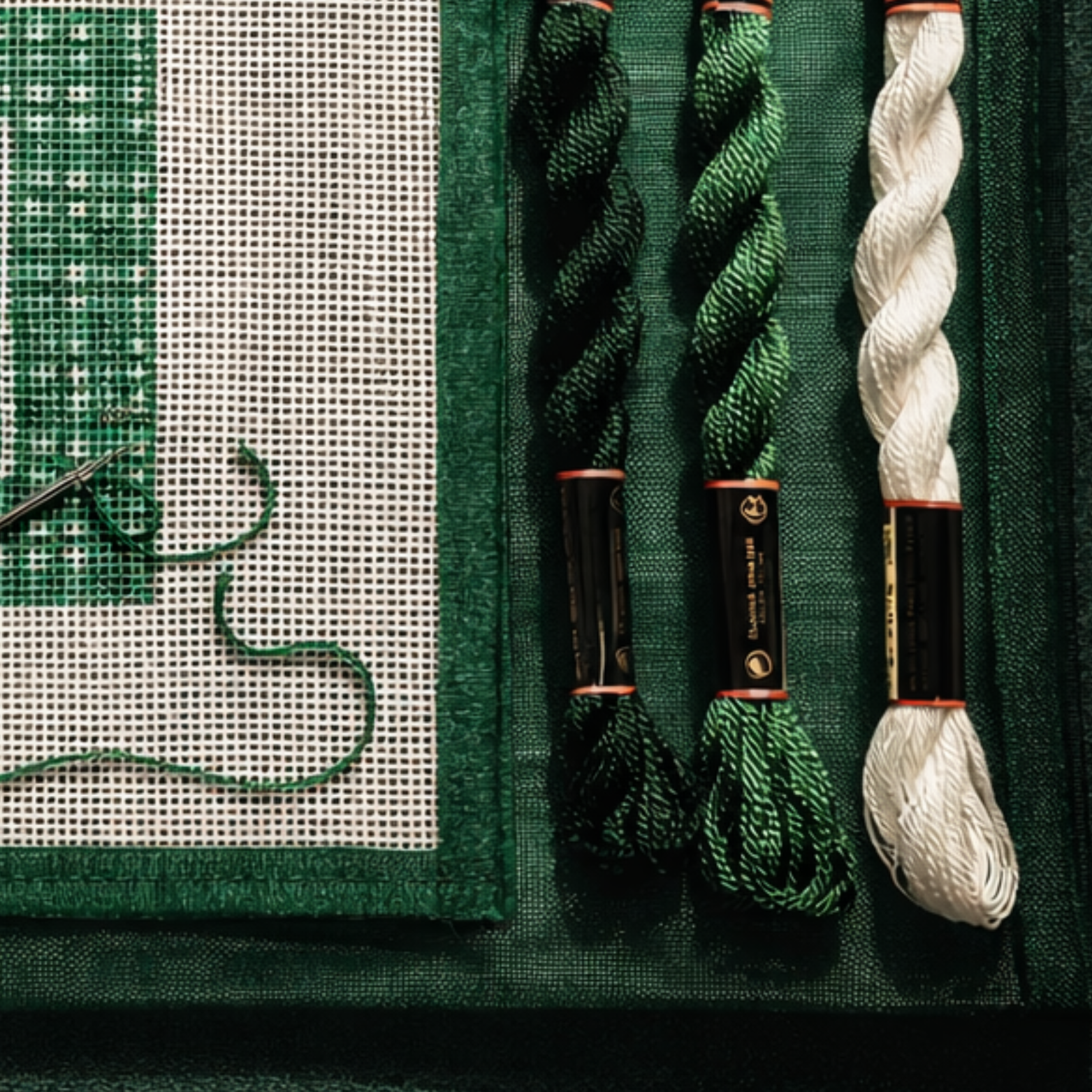
The first canvas asks for very little: the canvas itself, a tapestry needle suited to its mesh, and thread in the colors of the design. A Pierrepont kit brings those three things together, with the threads cut and labeled and a color key that tells you how many strands each color wants. Stretcher bars hold the canvas square while you work; small, sharp scissors make clean work of the ends; and a needle minder keeps the needle from vanishing into the folds of a chair.
Kits · Tools & Accessories · Threads
The Words
Needlepoint has a language of its own: mesh count, skein, dye lot, frogging, Finishing with a capital F. Most of it can be learned in an afternoon, and none of it should stand between you and the pleasure of beginning. The Glossary gathers that language in one place, from the terms you will meet while choosing a first canvas to the fibers and techniques that come later, with an alphabet down the side so that one idea leads to the next. Read what you need now, and let the rest wait until the craft brings you there.
The Two Stitches
Nearly all of needlepoint grows from one small diagonal stitch, worked in two ways. Continental moves back and forth across the canvas and is the simpler place to begin; Basketweave moves diagonally, distributing the pull of the thread so that the canvas stays square as larger areas fill. Learn Continental first and turn to Basketweave for larger fields and backgrounds; between them, they will carry you through any Pierrepont canvas. The Stitch Guide teaches both, with cards you can print and tuck into your project bag.
Choosing a First Canvas
Your first canvas should leave room for pleasure: it should be small enough that the end remains in sight, printed on a larger mesh canvas so that the holes are easy to see, and composed of broad fields of color that allow your hand to find its rhythm. I keep a shelf of beginner canvases chosen with exactly this in mind, and each is available as a kit so that you can begin with everything in its place.
Choosing a Thread
The thread you choose gives the finished piece much of its character, and the choice is less about difficulty than about the kind of beauty you want it to hold. DMC Pearl Cotton is the classic, with a soft luminosity and a color for almost anything; Pepper Pot is pure silk and gives the surface the gleam of satin; Radiance is a metallic that brightens a piece with the glimmer of candlelight. Every Pierrepont kit includes a printed color key, so you can choose by feeling and leave the counting to us.
When the Needlework Is Complete
A worked canvas is not yet a finished object. Blocking returns it to true, and construction turns it into the thing it was always meant to be: an ornament, a pillow, a stocking, or a small stand-up for a shelf. Send your canvas to Pierrepont, and we will carry it through those final steps before sending it home to you.
The Pierrepont Post
From time to time, I write a letter about the world behind the canvases—the history of toile, a village of six houses that appears only in the fall, the reading that keeps me company at the frame. Every letter is kept here in the Library, for an afternoon when you would like the company.